Tuesday, 14 August 2012

Edinburgh Architecture

Yesterday I went to hear the wonderful Paul O'Keaffe deliver the first of John Ruskin's Edinburgh Lectures as part of the Edinburgh Fringe, a wonderful and often hilarious tour de force of insight and irreverence as he slates the famous Edinburgh New Town to the men and women who built it, and teaches them instead an appreciation of his favourite Gothic architecture:

"Gather a branch from any of the trees or flowers to which the earth owes its principal beauty. You will find that every one of its leaves is terminated, more or less, in the form of the pointed arch; and to that form owes its grace and character. I will take, for instance, a spray of the tree which so gracefully adorns your Scottish glens and crags—there is no lovelier in the world—the common ash. Here (fig.4) is a sketch of the clusters of leaves which form the extremity of one of its young shoots. Observe, they spring from the stalk precisely as a Gothic vaulted roof springs, each stalk representing a rib of the roof, and the leaves its crossing stones; and the beauty of each of those leaves is altogether owing to its terminating in the Gothic form, the pointed arch. Now do you think you would have liked your ash trees as well, if Nature had taught them Greek, and shown them how to grow according to the received Attic architectural rules of right? I will try you. Here is a cluster of ash leaves, which I have grown expressly for you on Greek principles (fig. 6). How do you like it?"
I have now got Ruskin Spectacles on as I walk around Festival Edinburgh. Today the new entrance to Waverley Station was opened. Ruskin described it precisely:

Well, but, you will answer, you cannot feel interested in architecture: you do not care about it, and cannot care about it. I know you cannot. About such architecture as is built nowadays, no mortal ever did or could care. You all know the kind of window which you usually build in Edinburgh: here is an example of the head of one: a massy lintel of a single stone, laid across from side to side, with bold square-cut jambs—in fact, the simplest form it is possible to build. It is by no means a bad form; on the contrary, it is very manly and vigorous, and has a certain dignity in its utter refusal of ornament. But I cannot say it is entertaining. How many windows precisely of this form do you suppose there are in the New Town of Edinburgh? And your decorations are just as monotonous as your simplicities. How many Corinthian and Doric columns do you think there are in your banks, and post-offices, institutions, and I know not what else, one exactly like another?—and yet you expect to be interested!

And then there is this description of how we put up a new building which reminded me irresistibly of my church's proposed 'development', which will remove my favourite suntrap terrace in Edinburgh and replace it with an oversized porch at a cost out of all proportion to any other church activity:
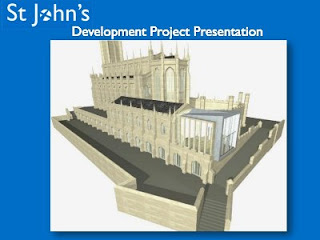
In your public capacities, as bank directors, and charity overseers, and administrators of this and that other undertaking or institution, you cannot express your feelings at all. You form committees to decide upon the style of the new building, and as you have never been in the habit of trusting to your own taste in such matters, you inquire who is the most celebrated, that is to say, the most employed, architect of the day. And you send for the great Mr. Blank, and the Great Blank sends you a plan of a great long marble box with half-a-dozen pillars at one end of it, and the same at the other; and you look at the Great Blank's great plan in a grave manner, and you dare say it will be very handsome; and you ask the Great Blank what sort of a blank check must be filled up before the great plan can be realized; and you subscribe in a generous "burst of confidence" whatever is wanted; and when it is all done, and the great white marble box is set up in your streets, you contemplate it, not knowing what to make of it exactly, but hoping it is all right; and then there is a dinner given to the Great Blank, and the morning papers say that the new and handsome building, erected by the great Mr. Blank, is one of Mr. Blank's happiest efforts, and reflects the greatest credit upon the intelligent inhabitants of the city of so-and-so; and the building keeps the rain out as well as another, and you remain in a placid state of impoverished satisfaction therewith; but as for having any real pleasure out of it, you never hoped for such a thing. If you really make up a party of pleasure, and get rid of the forms and fashion of public propriety for an hour or two, where do you go for it? Where do you go to eat strawberries and cream? To Roslin Chapel, I believe; not to the portico of the last-built institution.

There are several buildings in Edinburgh, built between perhaps 1870 and 1940 - the National Portrait Gallery, the war memorial chapel in Edinburgh Castle and Fairmilehead Parish Church for example -- which I'm sure were fairly directly inspired by the Ruskin mindset. Ruskin has his cons as well as his pros -- he talks some right rubbish sometimes. But I wouldn't mind if the current architects of Edinburgh were a little more inspired by his nature-inspired, anti-pretentious, thinking.

I once thought his 'seven lamps' of architecture a mantra worth committing to memory: Truth, beauty, power, memory, sacrifice, obedience, life. There's a test for soundness in a building -- or a person!

Wednesday, 8 August 2012

Robert Downie and the big heart of Regency Edinburgh

200 years ago today, on 8 August 1812, the Caledonian Mercury newspaper noted the arrival of a new face in Edinburgh. They didn't even know his name, but he must have made an impressive entrance:
He was Robert Downie: he was 41 years old, vastly rich, and he had come home. 

Robert Downie's father was a farmer and distiller in Spittaldon, half way between Stirling and the Trossachs: perhaps he was one of the moss lairds  who migrated from the Highlands to drain the bog and improve the lands of the Forth Valley. Downie himself undertook a far longer journey to seek his fortune, to India.

Spittaldon, Menteith, Stirlingshire

Most of the Edinburgh New Town residents I have studied who made fortunes in India enjoyed an official appointment in the East India Company, courtesy of the patronage of Henry Dundas. Robert Downie had no such privilege. He went to Calcutta, where private 'Houses of Agency' were springing up from the 1780s. They financed ships and plantations, ran banks and insurance, and arranged cargoes and remittances. By 1800 they were so successful that their trade in Bengal eclipsed that of the Company. Downie rose to become a partner in one of these houses, Downie and Maitland, which later metamorphosed into the more well-known Cruttenden, MacKillop and Co.

In 1804, aged 33, He married Mary, 18-year-old daughter of one of the Establishment: Joseph Barnard-Smith, a rising merchant in the East India Company. By the time he returned to Scotland the couple had four daughters, Mary, Georgina, Roberta and Harriet, although Mary died soon after their arrival. 

The Downies settled at no.20 Charlotte Square, where in 1814 Mary had a son, also Robert. The residents of Charlotte Square were amongst the wealthiest in Edinburgh, but were notable for their mixed social backgrounds: William Arbuthnot at no.16 was the son of a failed businessman in Aberdeen. Henry Cockburn at no.14, opposite his friend John Tod at 46, came from solid local landed families, and had risen in the legal profession. Next door to the Downies at no.19, Thomas Allan came from a dynasty of Edinburgh bankers. At no.7, with a longer pedigree but a shorter pocket, the clan chief John Lamont of Lamont was on the point of having to sell up, his ancestral wealth unable to keep pace with these beneficiaries of Scotland's economic miracle.

Yet this was before the days when Edinburgh turned in on itself and peeked at its neighbours from behind lace curtains. These first inhabitants of Charlotte Square, many of whom had young children, formed a flourishing community characterised by long and happy marriages, an idealistic belief in their ability to  improve their society, and an abundance of good food in informal settings. Picnics in the Pentlands, jaunts to country houses, and suppers at in one another's parlours form (along with politics and civic engagement) the material of their letters. Downie, the mysterious traveller from another world, had arrived in what appears to be history's happiest communities.  

Downie threw himself into the Scottish craze for Improvement. Three years after his return, he was chair of the Company which promoted the Telford's Union Line of the canal from Edinburgh to Glasgow, in opposition to the Town Council who were championing an impractical and circuitous 'Upper Line'. The Union Line was ultimately successful, and Downie, the major shareholder, gave his name to the street (Downie Place, now a part of Lothian Road) which looked onto the final port in the canal, Port Hopetoun, which came in under a bridge over Semple Street and filled the area between Semple Street and Lothian Road.

The original Union Canal basin facing the Canal Company's own street, Downie Place, now a section of Lothian Road containing some very useful shops. From John Wood's 'Plan of the City of Edinburgh' (1831)

Robert Downie was a religious man, and his philanthropy suggests a certain greatness of heart. He was a major investor in the Episcopal Chapel of St John's which was built in 1818 conveniently between his house in Charlotte Square and his Canal site on Lothian Road, and a member of its first Vestry. On his return from India he had bought the Highland estate of Appin from the Marquis of Tweeddale. Thirty years later, the Presbyterian minister of Appin said of him, 'I do not think that there is a parish in Scotland in which the Episcopalian heritors deserve at the hands of the Establishment more honourable mention'.

St John's Chapel in 2012: the canal has been superseded as a form of transport by the buses, and the Town Council's latest transport lark, the trams, are under construction.


Downie had learned Episcopalianism in India, where the Anglican Church predominated. On the mosses of Spittalton he had been brought up a Presbyterian, and one might imagine that he would be eager to erase this lowly past, and remain the mysterious traveller whose history began in India. Yet soon after his return to Scotland he 'presented to the congregation of Norriestown, an elegant service of four silver communion cups, as a tribute of the regard for that religious establishment, which he attended in his youth.'

Downie went on to enter parliament for the Stirling Burghs, and died in 1841. A shrewd businessman yet generous, open-minded yet committed to his beliefs, travelling the world yet attached to places, Robert Downie was one of the people who made Regency Edinburgh such an exciting place to be.


More information and sources are available on Robert Downie's page at The Episcopal Congregation of Charlotte Chapel project website.

Thursday, 26 July 2012

Put on Sackcloth

Fractal Time

Human beings are bad at judging scale. 'I could just run up there,' I think, contemplating the tempting green slope of a shapely mountain: an hour later, plodding over rock and heather, I realise how distorted my perspective was.


History is the same. Biologists, speaking of evolution and extinction of species; geologists, speaking of tectonic plates and the creation of rocks; astronomers, speaking of star formation, all construct chronologies which look very similar to the chronologies I, a historian, construct of the development of the New Town of Edinburgh: important events, long trends, and generalised details in between.

Yet the generalisations of one are the detailed chronology of another. Time (our various chronologies) and space (my underestimated mountain) tend to be structured fractally: the detail looks very similar to the big picture. The best way to understand this is to dive into the Mandelbrot set. The detail of this mathematically-defined shape is unlimited, and repetitive: the original lumpy shape keeps turning up in the infinitesimal threads which spun out of it:


If you want more control over your exploration of the Mandelbrot set, have a play with this interactive version

It's a mathematical construct, but it's also a deep insight into the way nature is constructed.


Important Events

While scientists and mathematicians have taught us a huge amount about these great timescales of Earth's history -- extinctions, tectonics, climate shifts -- we have not experienced any of it.


This graph shows marine extinction intensity through time: the coloured letters at the top are geological era, the figures at the bottom millions of years. The spike marking the end of the 'K' era (Cretaceous) and the beginning of 'Pg' (Paleogene) is the disappearance of the dinosaurs, 65.5 million years ago. Our genus Homo evolved 2.3 million years ago, the last tenth of the 50-0 division on the graph. Homo Sapiens around 250 thousand years ago, the last twohundredth of that last division. You would have to zoom a long way into that graph, as you zoomed into the Mandelbrot Set, to find the significant events of my history research -- or the significant events on your facebook timeline. Yet, like the Mandelbrot set, they're all on one line: the History of the Earth.

You will quickly perceive that it is statistically very unlikely for a human being to witness a mass extinction event. All the generations of humanity that ever lived are encompassed in that smudge at the end of the graph, where the extinction rate happens to be very low. The typical human need not fear that the earth they inhabit will be disrupted by events from the bigger chronologies.

Stastistically unlikely. Yet we are not dropped at random into the timeline of human history: we are at the end of it, living it forwards; and the scientific consensus is that a mass extinction event, caused by human activity, is likely to occur in our lifetimes:
We now face losing marine species and entire marine ecosystems, such as coral reefs, within a single generation. Unless action is taken now, the consequences of our activities are at high risk of causing, through the combined effects of climate change, overexploitation, pollution and habitat loss, the next globally significant extinction event in the ocean. It is notable that the occurrence of muliple high intensity stressors has been a pre-requisite for all the five global extinction events of the past 600 million years. (Summary of the conclusions and recommendations of the international Earth system expert workshop on ocean stresses and impacts, 20 June 2011)
Ocean biodiversity may seem rather abstract to us land-based creatures, but it is the indicator biologists use to measure the health of life on earth, on which we clearly depend for our survival. Have you ever been faced with the question 'Where will my next meal come from?' I am lucky enough that I never have: perhaps you have, but in generally it will be an unusual situation for readers of this blog. Our civilization is based on the highly efficient farming of animals and crops, requiring a stable climate, a reliable water supply, pollinating insects, genetic diversity, oil, mined phosphates -- all of which are critically under threat, running short, or (in the case of oil) compounding the problem.

This Financial Times article explores the disastrous consequences of the unseasonable drought in the US for food prices; while the wet weather in Britain threatens disastrous levels of disease. If such unstable weather patterns become, as is predicted, typical of higher carbon-dioxide levels in the atmosphere, then it is easy to see how yields will fall, the question 'where will our next meal come from?' will occupy more and more political and personal attention, and 'there is no next meal' will be the final answer for more and more of the poorest on this planet -- not in future generations, but in forthcoming decades.

What did you have planned for future decades? I was planning to write great books, travel more, sing, form deep friendships and have exciting love affairs. I'm in my prime, healthy, educated, and ready to live life to the full. I want to keep my human timeline safely within the unimportant detail of the biological and geological timelines. I am not interested in an apocalypse.

But... but... I can't live other than by this maxim:
The greatest thing a human soul ever does in this world is to /see/ something, and tell what it /saw/ in a plain way. Hundreds of people can talk for one who can think, but thousands can think for one who can see. To see clearly is poetry, prophecy and religion -- all in one. (John Ruskin, Modern Painters, pt.4 ch.16 para.28)
All I can do is tell what I see.


Apocalypse

A mass extinction event, within a generation and caused by us. It could not have been predicted two hundred years ago, when the man I envy most in history, Henry Cockburn, could write this from his house here in Edinburgh:
My hope is in the ultimate force of truth, reason and common interest. By these I hope for a union of all wise and good men in the common cause... till by the correction of evils or abuses, even the lower orders may be interested in the preservation of their privileges and more acknowledged rights... International rights and intercourse growing and more respected every day! The press making the world one audience, capable of receiving at once whatever instruction wisdom may have to give, or whatever feeling virtue may have to inspire! Our sons may see the fulfilment of these glorious things. Happy are we who have been permitted to 'scent the morning air'. (Henry Cockburn to Sir Thomas Dick Lauder, 30 December 1830)
Who amongst us writes about the life of the generations ahead of us? What would we write if we did? We are too terrified to acknowledge our terror. Most of us scramble to participate in collective events to reassure us that the global community is OK: the Jubilee, the Tour de France, the Olympics, Harry Potter, Fifty Shades of Grey. The courageous and dedicated, ready to face their fears and find solutions, scorn such escapism and pour the best of their resources and abilities into solving the global economic crisis and into seeking ways to direct the Arab Spring towards flourishing democracy. The wise and enlightened work to remedy the lingering injustices that corrupt our societies: gun crime, homophobia, oppression of women, child poverty, financial scandal. The sensible disengage from the global perspective altogether and seek to live harmlessly on our little spot on earth: with real friends, a vegetable garden, creative interests. The environmentalists continue to talk in terms of solving the problem: successful conservation efforts, achievable international agreements, little actions you can take which add up to global solutions. It is the only way they know to 'sell' their message; but increasingly the 'achievable solutions' are so blatantly unachievable that they are merely an extra screen to help them shield them from the truth. Here's a great example, by myself a few years ago, depicting a 'green' lifestyle:


Living in an Age of Mass Extinction

It is likely that (unless we are killed off early in the process) the rest of our lives will be spent watching the collapse of life on earth, and the collapse of human civilization. It's fairly likely the adaptable Homo Sapiens will survive the experience, just as Inca genes probably survive somewhere in the population of South America, but I'm certain that almost all our culture won't. To me this is a spiritual problem. I can deal with my own mortality -- knowing that the things which made my life worth living don't die with me: love, poetry, music, larks, literature, laughter, Christmas, harebells, history conferences, discussions about the meaning of life which last until two in the morning. It's that reassurance that I've been denied.

What I see terrifies me.

For a start, it's a very lonely experience, because no-one else is talking about this. Am I in fact wrong and insane? -- a far less terrifying prospect than the possibility of being right. But suppose I'm not insane? Suppose I'm talking sense, and you've read this and followed my thought process. Now you are terrified too. Here we are, enlightened, rational, educated, sensible people, starting to think in terms akin to the more ridiculous of history's religious apocalyptic movements, terrified.

What do we do?

Well -- I'm not sure. I have tried to see things clearly, and I've tried to tell you what I've seen. The two responses I've generally had when discussing this are either 'I don't think it's as bad as you make out', and 'right then, let's work out how to fix this'. If you are inclined to give the first response, I would like you do a bit of research and back it up by evidence please, as my argument is. If you're inclined to give the second, I'd suggest we're too late: we can't fix it, because we are seeing the beginning of consequences of damage already done.

It is noticeable how the advice of the scientific community has moved from 'averting dangerous climate change' to 'adapting to climate change'. This is one perhaps valid approach, which will appeal to all of you who need to be doing something active, and I suggest you start your studies at the Intergovernmental Panel on Climate Change, who have recently published a special report on this topic.

However, I am pessimistic about the possibility of action. All the important indicators -- burning fossil fuel, global population growth, biodiversity loss -- continue to accellerate. The fact that oil companies are likely to start drilling in areas made accessible by the retreat of Arctic ice due to climate change is symptomatic of how we are not changing. The global consensus and transformation of priorities required at every level of policymaking and personal decision making is too enormous. We imagine that it is fairly easy to bring the world to one mind, because the world all collectively said 'Ahhh!' when Will and Kate got married. But that is a very different thing from being prepared to change our lifestyle completely. If you are for action, are you prepared to lead the way? Reduce your environmental footprint to 15 hectares?

The story I keep coming back to is one which has had little relevance in our enlightened civilization: the ancient Jewish story of Jonah* (Please refer to footnotes if you are troubled by the religious turn in this article) Once all that whale saga is out of the way, the story continues in the bald narrative characteristic of old texts:
Jonah obeyed the word of the Lord and went to Nineveh. He began by going a day’s journey into the city, proclaiming, “Forty more days and Nineveh will be overthrown.” The Ninevites believed God. A fast was proclaimed, and all of them, from the greatest to the least, put on sackcloth. 
When Jonah’s warning reached the king of Nineveh, he rose from his throne, took off his royal robes, covered himself with sackcloth and sat down in the dust. This is the proclamation he issued in Nineveh: 
"By the decree of the king and his nobles: 
Do not let people or animals, herds or flocks, taste anything; do not let them eat or drink. But let people and animals be covered with sackcloth. Let everyone call urgently on God. Let them give up their evil ways and their violence. Who knows? God may yet relent and with compassion turn from his fierce anger so that we will not perish." 
When God saw what they did and how they turned from their evil ways, he relented and did not bring on them the destruction he had threatened.

The fictional people and King of Nineveh faced catastrophe, just as we do. The important thing to realise is that they knew they were completely powerless to stop it -- just as we are -- and being powerless was just as horrible and terrifying for them as it is for us. Jonah told them 'Nineveh will be overthrown', not 'Unless you change your ways, Nineveh will be overthrown'. They didn't dress in sackcloth and fast because they thought it would work, but because faced with the knowledge of their certain imminent extinction due to their own fault, repentence and mourning was the only possible response. And once they had stopped everything they were doing, and truthfully faced the enormity of the disaster they had brought upon themselves, they unexpectedly found a glimmer of hope.

We don't really do mourning and repentance in our culture: we do action and fixing -- but that is how the Nineveh is depicted too. They weren't fasting at the drop of a hat, like the godly commonwealth of seventeenth century Scotland: they were much more like us. Mourning and repentance wasn't 'their thing', but faced with Jonah's news, they couldn't do anything else.

Mourning and repentance is my response to this situation, which sounds like more completely counter-cultural lunacy than saying that environmental disaster is upon us. 'Don't beat yourself up with guilt, but look forward, become the person you wish to be!' my religious traditions tell me, as they campaign optimistically for gay marriage and women bishops. No, I reply: you have two thousand or more years of tradition behind you, but you have forgotten it, and live in the paradigm of the beautiful new humanist myth of the happy Henry Cockburn: 'My hope is in the ultimate force of truth, reason and common interest... Our sons may see the fulfilment of these glorious things...'

In fact, 'our activities are at high risk of causing the next globally significant extinction event'. I think we need to mourn, I think we need to repent: I think doing so will mess up our lives monumentally (Sackcloth??), but I think our lives are going to get messed up soon anyway. And then once we've stopped, and mourned, and repented, then I think we need to ask, how do we live well in the face of environmental catastrophe? Most writing about ethics we hear is consequentialist: 'The US must tackle gun laws because 32 people are murdered with a gun each day'. More foolishly, much that masquerades as virtuous and grand is about pride: 'We are proud to be Scottish', for example. Consequentialism and pride, which form so much of our ordinary moral compass, are meaningless in the face of environmental catastrophe.

Yet things like compassion, generosity, hospitality, humility, mercy -- the more curious and inexplicable virtues, the ones which appear in stories of the guillotine or the gas chamber -- they seem to ring more true to me than they ever did as I contemplated enjoying my prime like an enlightened Jean Brodie. When the destruction of all our loves and hopes and longings is just a blip buried deep in the fractal timeline of the universe, I think I want to know that humanity encountered the catastrophe in a way that gave it a little transcendence.

Put on sackcloth.

And when the last and dreadful hour
This crumbling pageant shall devour
The trumpet shall be heard on high,
The dead shall live, the living die,
And music shall untune the sky.
John Dryden, 1687.


Notes


* The non-religious amongst you needn't worry that all that miraculous whale business seems unlikely: whereas some Biblical characters like Jeremiah are semi-historical, I don't think Jonah was ever intended to have been thought real: they are like Thomas a Becket and Robin Hood in our own history: one real, but surrounded by legend, the other fictional, but highlighting important aspects of the society which dreamed him up. If you don't like 'God' please interpret the word in as unreligious a way as you like: my own understanding of 'God' is more of a 'collective life force' -- the sum of the consciousness of biosphere and civilization -- and therefore facing just as bleak a future as the rest of us. 'God' as I understand the word does have a sort of mysterious transcendence which we encounter in our more spiritual moments, but no 'external existence'. I'm not sure if that explanation will put off my religious or secular readers more quickly -- but I would remind you that we are facing imminent catastrophe, and this is not the time or place for arguing about definitions of 'God'. 'Let everyone stop and think clearly about what we are facing: who knows, maybe by doing this we will start to find a way through' might be a secular rephrasing of the King of Nineveh's command.

**I'm addressing religions not to the exclusion of the non-religious, but because their purpose is to proclaim the truth and advise on how to act accordingly, and that's what I'm attempting to do too; and because it's a constituency I'm familiar with, who are likely to form a large proportion of my readership, and who might be most likely to understand what I'm getting at.

Saturday, 19 November 2011

Making History

As a member of the Choir of St John's Edinburgh, I am part of the same spiritual community whose predecessors, 200 years earlier, I am researching for a PhD. Today, more than ever before, I had a sense of being part of an event which was important in the history of the church: the choir sang at the first blessing of a civil partnership between two men. There is now an entry in the church registers unlike any before it.

St John's, Edinburgh, November 2011.

There is also an entry in the congregation's registers for November 1811. William Arbuthnot's son Henry Dundas Arbuthnot was baptised by Bishop Daniel Sandford, the first rector of St John's. William Arbuthnot was an important Edinburgh civil servant, a founding vestrymember of St John's, with a large townhouse in Charlotte Square, and a long landed pedigree in Aberdeenshire. He became Lord Provost in 1815, and again in 1822 when he hosted the memorable visit of George IV to Edinburgh. His baby son was named in honour of his political patron Henry Dundas, the 'uncrowned king of Scotland'. Dundas held unshakeable dominance over Scottish politics throughout the period of the Napoleonic Wars, and, while he did much to make Scotland and Scots significant in Britain and the Empire, he was also severely criticised for his  illiberal regime, run for the benefit of his friends.

Baptism of Henry Dundas Arbuthnot, November 1811

Two hundred years on, St John's gave its blessing to, and entered into its registers,  the partnership of two people from a group who for hundreds of years have been misunderstood, hidden and persecuted in very real ways, for simply loving each other. The significance of this struck me very powerfully during the service. Although we in the choir didn't know the couple, we too were invited into the circle which formed around the altar to witness their vows and exchange of rings. Singing the final hymn in this circle, the choir felt strongly the generosity of the welcome we received.

Those who know me will know that I'm pretty cynical about churches. I'm too conscious of their William Arbuthnotiness: on the right side, knowing the right people, attempting to dish out spiritual benefits from their position of confident establishment: spiritual benefits which are too often rotten.

But today I watched an institution which purports to purvey good news to all of the love of God really do just that. There was no room for cynicism. I'm quite proud to be a Christian. I don't think I've ever said that before.

But let's not be too hard on our poor predecessors, celebrating the baptism of little Henry Dundas Arbuthnot in November 1811. The congregation had been part of the Scottish Episcopal Church for less than a decade. Less than twenty years earlier, it had been illegal to be Episcopalian, and only six years before they were still regarded as marginal and unacceptable. Through close communication with Scottish Episcopalians to resolve the remaining issues, joining his prestigious congregation to the Episcopal Church, and deliberately generous and inclusive preaching, Rev Daniel Sandford demolished that remaining prejudice, as his successor Rev Donald Reid demolished prejudice today.

In the history of a spiritual institution, it is right that it is events and individuals  characterised by striking humility and generosity which shape it and become historic, rather than glorious talent or brilliance. But there is a big challenge, both for the spiritual institution and for those nourished by it -- whether the gay community or a cynical historian. I said I felt proud to be a Christian today: I hope the couple were too. But how easily, as the memory of persecution fades, to keep the pride, and forget the humility and generosity by which we earned it.

So when in 2211 some successor of mine writes about this moment in our history, what new persecution and exclusion might we, in our pride, have created? And how can we make a history which ensures they never have cause to write about it?

Monday, 5 September 2011

Creationtide: Year of Forests

Here are the Intercessions I wrote for St John's Church on the first Sunday of Creationtide (which runs from now until 10 October), marking International Year of Forests. You're welcome to make use of these in your church or other contexts: please leave a comment to let me know.

Father, root of our being; Jesus, apple tree in us,
Spirit, oxygen in us: One tree of life, our salvation, hear us.

Root of existence, life from whom all life has sprung, now ground us.
Fashion humanity new in your ancient image: gardeners
nurturing, cherishing, planting the woods of the future. Fill it a-
gain with mercy, compassion, humility, grace, love, justice. As
spring in the earth brings forth her bud, bring forth your righteousness
over the nations.  Lord in your mercy, hear our prayer.

Tree of life among us, laden with fruit and green, of the
stem of Jesse, nourish your Church that we may be fruitful.
Drive out with heaven's abundance the idol of wealth that cheats us with
scarcity, makes us efficient with greed and careless of justice:
Lord in your mercy, hear our prayer.

Oxygen, life-breath, stirring, sustaining, rekindling hope now,
heal our brothers and sisters in need, despair or in sickness.
So as the natural tree by light makes the poisoned air healthy, for
fears by your grace all-divine we receive back hope. In the silence we
breathe them to you ..............................................................................
..........................................................Lord in your mercy Hear our prayer.

Father, root of our being, ground us,
Jesus, apple tree with us, redeem us,
Spirit, again photosynthesised here to sustain us,
Make us planters of trees and proclaimers of you.

Follow me on Facebook :: Follow me on Twitter

Wednesday, 10 August 2011

Goodbye Bovril Factory

It used to be on my route to school, and then to work. We called it the Bovril Factory, because of the marmite smell of hops which hung over our whole area.

Brewing has been one of the chief industries of the south-west of Edinburgh since at least the sixteenth century. The name 'Bristo' (where Edinburgh University now is) comes from 'Brewster'. The reason the area has also become a centre for the arts is thanks to the profits of brewing: both the McEwan and Usher concert halls were named after the brewers who built them.
Bristo Square and the McEwan Hall, from Layers of Edinburgh

It was McEwan's company who built the Fountain Brewery, moving out from the now-gentrified Bristo area into a cheaper industrial suburb to the west, with the convenient transport link of the canal. The twentieth-century brewery building was the latest addition to a well-established industrial area, many of whose quirky and beautiful earlier buildings have been preserved. Sharing the Fountain Brewery site was an old Rubber Factory, whose curving profile makes it appear to be built from its own product, instead of brick -- an unusual material for Edinburgh, but characteristic of Fountainbridge. It has survived the demolition so far, at last un-dwarfed by its surroundings, and I hope will be preserved.

The rubber factory (left) behind the nibbling dinosaurs which revealed it, and the last and highest part of the Fountain Brewery (right) still mainly intact in July. The foreground is the canal towpath.
Our 'Bovril Factory' closed in 2004. Watching its demolition this summer has been endlessly fascinating. This morning, in an Edinburgh Festival downpour, I came past to find a dinosaur pulling the gigantic bovril jar from its shelf:


It's strangely reminiscent of the McEwans Lager ad where people are pushing giant spheres up endless flights of stairs in the rain. I hope the dinosaur gets a nice refreshing pint at the end of his day.

The photographer Dave Henniker has been recording the demolition, the strange buildings, the fantastically beautiful graffiti, elder and buddleia which has embroidered it all.

I can't say I'm too bothered about McEwans lager, being a devotee of the rather posher Deuchars IPA (which is still brewed in Edinburgh, just about a mile out further west). But I do miss the smell of the hops: the smell, for me, of home. And I'll miss this last sublime landmark of Fountainbridge's industrial history, and so will the jackdaws, starlings, swallows and doves for whom, these last few years this strange derelict iron cliff was also home.

It's supposed to be becoming hotels, shops, flats, well-kempt trees growing from paved boulevards, flash-flooding in a downpour. I hope it doesn't. I have a dream of another brewery billionaire coming along: a modern McEwan, creating the Fountain Gardens, green, with great spreading oaks and flowerbeds, lawns where ball-games are allowed, winding paths, fantastic fountains, beehives and birdboxes, little rowing-boats to hire on the canal, a museum of Fountainbridge history in the middle ... Well, one can dream. But if there are any billionaires out there, I know the perfect curator for the museum...


Follow me on twitter  (history mostly) Follow me on facebook (art mostly)

Layers of Edinburgh (the illustrated map)

Tuesday, 21 June 2011

Perfection and Freedom: high enlightenment in the Edinburgh New Town

I will give a half-hour talk this Sunday, 26 June, at 5pm in St John's Church, Princes Street. Admittance is free and wine will be served in return for donations.

In August 1792, as revolutionary crowds stormed the Tuileries and
France became a republic, the Reverend Daniel Sandford arrived in the
New Town from Oxford University, and advertised for pupils 'whose
education in the Classics he will superintend, paying particular
attention to the Grammar and Pronunciation of the English Language.'
In 1818, now Bishop of Edinburgh, Sandford built St John's Church,
where he ministered until his death in 1830. His ideology seems
strange to us now, and was old-fashioned even to early Victorians. Yet
his unique message, which married gospel truth with enlightenment
optimism, made him an important role model and inspiration to build a
better world to his influential New Town congregation.

This half-hour talk, first given at the Modern British History Network Conference, takes you back 200 years into the mindset which shaped the architecture and liturgy of our church. It will be followed by a short time for discussion, and at 6pm by a chance to experience that architecture and liturgy, at choral evensong.