I've just been watching a very poor BBC2 documentary about big, bad bankers. In a tone of impending doom, the narrator catalogued thirty years of now-familiar events which led to the ultimate crisis. For twenty years it seemed delightful: but we knew that it would all end in mis-selling, crash, small business owners in tears, and bankers facing the condemnation of society with a united viciousness I don't think I've ever seen exhibited against any other group of people before.
The condemnation of bankers and their `culture' is comprehensive. Bankers are thieves, swindlers, lacking `any common decency or honesty'. We will never trust a bank again. I can't remember ever hearing anybody, politician, commentator or acquaintance, in public or private life, defend a banker since the crash.
Well, the anger of the woman whose hotel will have to be sold to pay for her mis-sold insurance is entirely understandable, and she may easily be forgiven for not having a cool and detached perspective on the question. However, I believe the bankers deserve to be defended.
Not that I never did `trust' them either (but my friend Rob has already written eloquently on this side of the question, about other forms of business for whom the issues are exactly the same). But I don't condemn them, and I don't think anyone else who is in a position to take a considered view of the matter should either.
In fact, this kind of condemnation is the best way to avoid fixing the problem, and so ensure it happens again.
In a capitalist system, banks like all businesses are required to compete. They compete within rules, but within those rules, their task is to do everything they possibly can to out-compete the others. This, we believe, produces better results: if bread-production is nationalised, you will end up with horrible bread. If there is a free market, bakers will compete to produce ever-tastier loaves to entice customers.
Suppose it wasn't banking: suppose it was the Olympics. Within the rules, the athletes can, and must, do everything they can to win the game. If they break the rules, for example by taking drugs, or sabotaging another athlete's wheelchair, they will be fiercely disciplined.
But suppose one athlete realised that it would be more exciting for the spectators if she lost a few rounds of the game, so deliberately did so and perhaps then lost? Or suppose he knew that his rival's grandmother had just died, so let him win out of compassion? Athletes with such attitudes would probably not have made it anywhere near the Olympics. What about the athlete in the boxing, or shooting, event, who had a moral objection to boxing or shooting? That's just silly -- such a person couldn't even come into existence.
Sometimes the rules of the game require to be changed, to make it safer for the athletes, or more exciting for the spectators. The athletes' task is not to make the rules, but to compete within them, although a responsible athlete might notify the organisers of a change which they thought ought to be made. If the organisers refuse to change the rules, the athlete can put up with it, or pull out of the competition.
The best, most honourable athlete is the one who, at the end of the games, stands on the top of the podium and is awarded the gold medal. Only in very extreme and unusual situations does an athlete gain more credit for losing than winning. The Boston marathon runners who stopped yards from the finish line to help competitors injured in the bomb attack lost the competition, but were more than compensated, in terms of honour, by the excellence of their unselfish actions.
Sometimes there might be an athlete with a moral qualm he could not overcome which put him at a disadvantage, like the evangelical Christian Eric Liddell who refused to compete on a Sunday. If, despite this, he is selected for his team and wins competitions, he wins extra admiration: he has proved both high-minded and superhuman. Yet no-one expects athletes to handicap themselves with moral qualms, and those of more ordinary abilities who do so will have fallen out at far earlier stages in the competition.
So to return to the banks. The stakes are higher, but the structure is exactly the same. The bankers compete within the rules laid down for them. They are responsible to their customers and shareholders to do the best they can, as the athletes are to their team and the spectators. To discharge that responsibility they must be as ruthless and competitive as they can, within the rules.
The bankers themselves are not required to regulate their competition, but a responsible banker might suggest regulations which ought to be changed, and if they are not he must put up with it or leave the industry. I suspect quite a lot of bankers have done all these things over the past thirty years. However, I suspect the majority, like the majority of athletes, have been content to play their assigned role, and to leave the rule-making to those with that expertise. Indeed, athletes -- or bankers -- who were continually demanding changes to the rules might be criticised as impertinent, interfering, or not paying proper attention to their assigned task.
So when the banks increased their range of products, centralised branches, encouraged aggressive sales through performance-related pay, they were not thieves, or swindlers, or abusing trust: they were playing within the rules of the game they had been given. If they had backed off sales to allow their rival who had suffered a bad year to catch up, or used company money to give interest-free loans to poor people on a philanthropic basis, they would be rightly fired as ineffective bankers, or even prosecuted by shareholders for misusing company funds. Many people did leave the industry as the competition grew more cut-throat; so the individuals who remained were indeed the toughest and the most ruthless. Yet to condemn them for their culture or their ethics would be like condemning the boxer for hitting his opponent. They played within the rules.
Now, of course, those `values' of `trust' and `decency' to which everyone is appealing have become, literally, valuable. 9 Charlotte Square, Edinburgh, is being redeveloped as the headquarters of Scoban, a new bank promising `stable long-term client relationships', `no legacy "baggage"', `clean reputation', `respected and experienced banking and treasury staff' and `risk averse culture'. This is very nice, but I suspect that, in a free market, such commodities will fetch a high price, beyond the reach of most of us. (By the way, I can't help noticing that they have no women on their board, and only two on their senior staff, one of whom is the HR manager. That's another product, I believe, of the rules: not of some condemnable mysogyny of bankers -- but it suggests to me the rules might benefit from further change).
For twenty years, the game appeared to be benefiting everybody; a banker who foresaw the crisis that evolved would have been more far-sighted than the politicians who encouraged them or the customers who bought their products.
The BBC2 documentary ended with an orgy of vituperation against the big, bad bankers. At the last moment, however, the last word went to Justin Welby, who in my opinion spoke the first sensible words in the programme. He didn't condemn the bankers, blame them for creating a destructive `culture', or appeal to vague notions of `decent common basic traditional values' as voice after voice had been doing for the past ten minutes. He deplored the situation, and said, `we now have a chance to change the architecture, the structure of banking'.
It's not about trust, or decency, or good or bad. It's about deciding what rules you want to put in place. Stop blaming the bankers. Give them better rules, and get them back in their game.

eleanor m harris : colour : words : history : story : nature : literature : calligraphy : life
Thursday, 23 May 2013

Thursday, 9 May 2013
Love and Slavery: the story of James Grahame
The thing about writing the collective biography of 420 people, is that sometimes the people come back at you out of history and re-write you.
The advocate James Grahame (1790-1842) is one of those who inspires me more than most. An idealistic young scholar with literary aspirations, while at Cambridge University he fell in love. Matilda Robley was the daughter of a Cumbrian slave owner from St John's-in-the-vale, owner of hundreds of acres of plantation in Jamaica, and thousands of slaves. He abandoned his literary aspirations, trained as an advocate, argued himself out of his abolitionist principles, and in 1813 married her. Her old teacher wrote,
When his children were of age, they gave their shares up.
James Grahame loved deep and loved well, and that love shaped his life and the world around him. That's the kind of man who comes out of history and rewrites me.
Further reading:
Joseph Quincey, 'Memoir of James Grahame' in Collections of the Massachusetts Historical Society, series 3 vol.9 (Boston: Little and Brown 1846)
The advocate James Grahame (1790-1842) is one of those who inspires me more than most. An idealistic young scholar with literary aspirations, while at Cambridge University he fell in love. Matilda Robley was the daughter of a Cumbrian slave owner from St John's-in-the-vale, owner of hundreds of acres of plantation in Jamaica, and thousands of slaves. He abandoned his literary aspirations, trained as an advocate, argued himself out of his abolitionist principles, and in 1813 married her. Her old teacher wrote,
She is by far one of the most charming women I have ever known. Young, beautiful, amiable and accomplished; with a fine fortune. She is going to be married to a Mr Grahame, a young Scotch barrister. I have the greatest reluctance to part with this precious treasure, and can only hope that Mr Grahame is worthy of so much happiness.Grahame was so moved by the privilege of gaining her that it brought on a religious conversion, which lasted the rest of his life. His faith was described as that of 'the early Puritans and the Scotch Covenanters; but... sober, elevated, expansive, and free from narrowness and bigotry'. Tragically, Matilda died in 1818, and Grahame was left with his religion, his children, and the wealth. In 1827 he wrote,
My children are proprietors of a ninth share of a West India estate and I have a life-rent in it. Were my children of age, I coud not make one of the negroes free, and could do nothing but appropriate or forego the share of produe the estate yielded. Often I have wished it were in my power to make the slaves free, and thought this barren wish a sufficient tribute to duty. My conscience was quite laid asleep. Like many others, I did not do what I could, because I could not do what I wished. For years past, something more than a fifth part of my income has been derived from the labour of slaves. God forgive me for having so long tainted my store! ... Never more shall the price of blood enter my pocket, or help to sustain the lives or augment the enjoyment of those dear children. They sympathize with me cordially. Till we can legally divest ourselves of every share, every shilling of the produce of it is to be devoted to the use of some part of the unhappy race from whose suffering it is derived.
When his children were of age, they gave their shares up.
James Grahame loved deep and loved well, and that love shaped his life and the world around him. That's the kind of man who comes out of history and rewrites me.
Further reading:
Joseph Quincey, 'Memoir of James Grahame' in Collections of the Massachusetts Historical Society, series 3 vol.9 (Boston: Little and Brown 1846)
Sunday, 5 May 2013
Over the Hills and Far Away
Never mind the Lake Poets: Beatrix Potter is one of the most evocative and romantic of authors. I mean, look at this!

Over the hills and far away! Your dinner wrapped in a red pocket handkerchief, your clothes (in a style evoking a freer era before railway travel and crinolines) all fresh and neat, the ways parting, the hills blue...
It makes my heart beat faster: it always happens when I go up the Pentlands at the Edinburgh end: from the top of Allermuir you look south, and see the blue hills stretch away, away, ready to be skipped over, to ... where?
I looked on a map and found it was Carnwath, so I booked a B&B in Carnwath and on Friday caught the bus to Penicuik and, humming 'Tom, Tom the Piper's son' - or for a change 'Lilibullero' (I've got the eighteenth century on the brain) danced over the hills and far away.
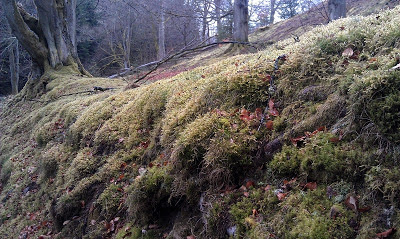
It began through the woods around Penicuik House (the eighteenth century is pursuing me, I tell you), which dripped with that other current obsession of mine: moss.
 It also dripped with rain. All the way up into the hills I kept thinking it might clear up, but it set in heavier. And heavier. Every time I got my map out it turned slightly more to papier mache, and soon the wind just blew bits of it away each time I got it out and I got well and truly lost.

My navigation descended to, Look! A feature! A kind of low point on the skyline! Let's head for it and see what we can see... I discovered later this was called Cauldstane Slap, which seemed appropriate.
The thing was, even in the pouring rain, what appeared from far off like the bleakest and most featureless of landscapes, is, under your feet, the most intricate, gorgeous tapestry of bright colours, rich textures and dazzling forms.
 It's like an illuminated manuscript so fine and detailed that from any distance it looks mushy brown: only close up you see the radient emerald, wild red, bright gold, delicate grey-green.
 I had swithered as to whether to find someone else to walk with this weekend. I find myself pretty irritating company, but I really wanted to test myself, have a sense of achievement, and not be held back by having to plan a sensible walk, and then hang around while they put their waterproof trousers, or stop for lunch (I'm a snacker-on-the-march), or argue about navigation. As it turned out though, I didn't have to put up with my own company, because the hills were my company, demanding my endless interest and attention with finding the route, battling the wind and rain, watching my step and finding my way over the pathless ground, and unrolling this stunning, endlessly variegated tapestry of moss, lichen, sedge, grass and heather under my feet. By the end of the walk I felt more chilled out and distracted from all the stuff than I have done for months.
However, I still didn't know where I was. My map had turned to mush (memo: get plastic map case). I was getting wetter and wetter in a pathless wilderness. But this was the reason I was doing this in the Pentlands and not (say) on Rannoch Moor: I knew reaching civilization would always be within my capabilities. I could see woods and a reservoir, and although I was sure it wasn't where I wanted to be, I decided I'd just better go for it.
It turned out to be ten miles up the A70, not a good road to walk along, but at least I knew where I was. I headed south about through fields, buggering about delicately in my perpetual fear of a. scaring lambs, b. trampling crops, c. damaging fences, d. committing some other blundering city-dweller transgression, until I reached a minor road which I could identify on my soggy shreds of map. It looped around half West Lothian. I went around three sides of a wind farm which I came to hate with a cordial hatred. I had the Binns and the railway line to Carstairs ahead of me -- places definitely in the 'over the hills and far away' category. But it did at last bring me to Carnwath.
I've never been so glad to arrive at a B&B. They said I was the wettest guest they'd ever had. I'd walked about 25 miles.
SO the next day dawned completely different.
 The map although somewhat shredded was dry and solid again. My new boots were a triumph. I was restored with steak pie, sticky toffee pudding, nine hours sleep and full Scottish breakfast, so I set off to do it properly.
The southern end of the Pentlands really are romantic. I didn't meet a soul in the whole two days, until I got all the way back to West Kip. The featureless wasteland of yesterday formed itself into evocative places: the high-point Craigengar; the Raven's Cleugh (I'm sure I've encountered that in literature? Walter Scott? John Buchan?). Most romantic of all, when I came down Bleak Law (!), the Covenanter's Grave:
 all wreathed in lichen, '...covering with strange and tender honour the scarred disgrace of ruin, laying quiet finger on the trembling stones to teach them rest...'
 Several miles on, a lonely rock formed the next significant feature in the landscape, all harlequinned in white, black and bright green:
 Everything was drenched and soaked and dancing with yesterday's downpour
 Merry with a million fountains
 Despite going by a reasonably sensible route, it was still at least 23 miles, or more given that even in the better conditions I faffed amongst low hills that all looked the same. I came over, I think, Cock Law -- the placenames just got better and better -- and got a sudden view of the Kips and Scald Law and all the familiar Pentland range with the Forth laid out lazily behind, all sunlit and homely-looking. But it was still about six miles to Penicuik, and although for the first time on the walk I was on paths, they seemed a very, very, very long six miles. I became obsessed by the thought that 'don't people sometimes do extreme sport things and then SUDDENLY DIE?' Going back through the woods south of Penicuik I had to keep having little sit-downs on fallen trees, where I pondered whom I should text to tell them my netbook password and to ask them to publish my novels posthumously. After about 50 miles of walking, I was pushing myself. I'd found my limitations.
I hadn't conquered the Pentlands, and they hadn't conquered me, but I'd got completely immersed in them, and come out clean and refreshed. It feels amazing. And I've been there: I've been over the hills and far away.

It makes my heart beat faster: it always happens when I go up the Pentlands at the Edinburgh end: from the top of Allermuir you look south, and see the blue hills stretch away, away, ready to be skipped over, to ... where?
I looked on a map and found it was Carnwath, so I booked a B&B in Carnwath and on Friday caught the bus to Penicuik and, humming 'Tom, Tom the Piper's son' - or for a change 'Lilibullero' (I've got the eighteenth century on the brain) danced over the hills and far away.
It began through the woods around Penicuik House (the eighteenth century is pursuing me, I tell you), which dripped with that other current obsession of mine: moss.


The thing was, even in the pouring rain, what appeared from far off like the bleakest and most featureless of landscapes, is, under your feet, the most intricate, gorgeous tapestry of bright colours, rich textures and dazzling forms.


However, I still didn't know where I was. My map had turned to mush (memo: get plastic map case). I was getting wetter and wetter in a pathless wilderness. But this was the reason I was doing this in the Pentlands and not (say) on Rannoch Moor: I knew reaching civilization would always be within my capabilities. I could see woods and a reservoir, and although I was sure it wasn't where I wanted to be, I decided I'd just better go for it.
It turned out to be ten miles up the A70, not a good road to walk along, but at least I knew where I was. I headed south about through fields, buggering about delicately in my perpetual fear of a. scaring lambs, b. trampling crops, c. damaging fences, d. committing some other blundering city-dweller transgression, until I reached a minor road which I could identify on my soggy shreds of map. It looped around half West Lothian. I went around three sides of a wind farm which I came to hate with a cordial hatred. I had the Binns and the railway line to Carstairs ahead of me -- places definitely in the 'over the hills and far away' category. But it did at last bring me to Carnwath.
I've never been so glad to arrive at a B&B. They said I was the wettest guest they'd ever had. I'd walked about 25 miles.
SO the next day dawned completely different.

The southern end of the Pentlands really are romantic. I didn't meet a soul in the whole two days, until I got all the way back to West Kip. The featureless wasteland of yesterday formed itself into evocative places: the high-point Craigengar; the Raven's Cleugh (I'm sure I've encountered that in literature? Walter Scott? John Buchan?). Most romantic of all, when I came down Bleak Law (!), the Covenanter's Grave:


I hadn't conquered the Pentlands, and they hadn't conquered me, but I'd got completely immersed in them, and come out clean and refreshed. It feels amazing. And I've been there: I've been over the hills and far away.

Thursday, 17 January 2013
Remembering Bishop Sandford
Last night I gave a lecture to the Old Edinburgh Club on Daniel Sandford (1766-1830), Bishop of Edinburgh 1805-30. This article is my personal response to that history, which is that the name of Daniel Sandford deserves to be remembered, both by his Church of St John, and by the people of Edinburgh.

Daniel Sandford founded the only congregation in Britain, as far as I can tell, where it was possible to be passionate about the enlightenment, passionate about the gospel, and passionate about Scottish Episcopalianism, all at once. It was hugely popular: his congregation outgrew two buildings in twenty years.
Thanks to this unique theology, Sandford drew the tremendous wealth, talents influence of hundreds of Episcopalians in the New Town into participation in 'Improvement' - getting the Enlightenment out of theory and into practice, in the structure of Edinburgh society. Without him, the history of Edinburgh might have been very different. When he died, he was affectionately remembered:
Yet Sandford was forgotten.
He was a peacemaker, seeing good in apparently opposing traditions. He encouraged Evangelicals for their warm, lively faith; but he would not countenance their challenges to official doctrine. He championed distinctively Scottish Episcopal ideas, but he objected to Episcopalian introversion and mysticism: his religion was for everyone. As a result, he was condemned by both sides in the partisan world of eccesiastical history. He has never had a champion - until me!
Sandford was serious-minded and shy in company. So he missed out on the other route to fame taken by his assistants Sydney Smith and E.B. Ramsay, whose witty and frivolous anecdotes kept their books in print and their bon-mots repeated to this day.
Meanwhile, forgetting why he was important, his own church of St John's carelessly lost him. His memorial in the sanctuary was removed to the baptistry in the 1880s when the sanctuary was enlarged. However, in the 1980s, the baptistry was converted into the church office, and Sandford's memorial, with its touching epitaph, is now completely invisible.
Sandford is buried just outside St John's, alongside some of his family. Yet his own modest, white gravestone has weathered into illegiblity.
Sandford also founded the Choir of St John's which is reason enough for me to champion him. I sit in the choir each week staring at the memorial of his successor as Bishop, James Walker, far better known but (in my opinion) far less distinguished.
I'm not sure Sandford would have wanted a big statue or giant cross. But hope that, sometime, the vestry might bring their predecessors' affecionate memorial tablet back down into the church, and remember the name of their gentle, influential founder.

Daniel Sandford founded the only congregation in Britain, as far as I can tell, where it was possible to be passionate about the enlightenment, passionate about the gospel, and passionate about Scottish Episcopalianism, all at once. It was hugely popular: his congregation outgrew two buildings in twenty years.
Thanks to this unique theology, Sandford drew the tremendous wealth, talents influence of hundreds of Episcopalians in the New Town into participation in 'Improvement' - getting the Enlightenment out of theory and into practice, in the structure of Edinburgh society. Without him, the history of Edinburgh might have been very different. When he died, he was affectionately remembered:
 |
| 'By all who venerate wisdom, sanctity and virtue, let this stone be held for ever sacred. In memory of the Right Reverend Daniel Sandford D.D. In the Scottish Episcopal Communion Bishop of Edinburgh, to record the gratitude of a church, which, to his piety, prudence and meekness, was mainly indebted for its union and prosperity, and of a congregation, which for thirty eight years, he led, by teaching and example, in the way of truth, peace and Godliness, this monumental tablet was erected by the vestry of the Chapel of St. John. Born July 1st 1766 Died January 14th 1830.' |
Yet Sandford was forgotten.
He was a peacemaker, seeing good in apparently opposing traditions. He encouraged Evangelicals for their warm, lively faith; but he would not countenance their challenges to official doctrine. He championed distinctively Scottish Episcopal ideas, but he objected to Episcopalian introversion and mysticism: his religion was for everyone. As a result, he was condemned by both sides in the partisan world of eccesiastical history. He has never had a champion - until me!
Sandford was serious-minded and shy in company. So he missed out on the other route to fame taken by his assistants Sydney Smith and E.B. Ramsay, whose witty and frivolous anecdotes kept their books in print and their bon-mots repeated to this day.
Meanwhile, forgetting why he was important, his own church of St John's carelessly lost him. His memorial in the sanctuary was removed to the baptistry in the 1880s when the sanctuary was enlarged. However, in the 1980s, the baptistry was converted into the church office, and Sandford's memorial, with its touching epitaph, is now completely invisible.
 |
| From inside the church, the top of Sandford's memorial is just visible in the alcove at the back, below the coat of arms |
Sandford is buried just outside St John's, alongside some of his family. Yet his own modest, white gravestone has weathered into illegiblity.
 |
| Sandford's grave, hidden in a shady corner behind the showy Dean Ramsay Cross |
Sandford also founded the Choir of St John's which is reason enough for me to champion him. I sit in the choir each week staring at the memorial of his successor as Bishop, James Walker, far better known but (in my opinion) far less distinguished.
I'm not sure Sandford would have wanted a big statue or giant cross. But hope that, sometime, the vestry might bring their predecessors' affecionate memorial tablet back down into the church, and remember the name of their gentle, influential founder.
Tuesday, 20 November 2012
'We could still prevent climate change'
Today New Scientist published seven reasons Climate Change is worse than we thought. It makes depressing reading. Most of us want to believe that humanity has the capacity to fix the problems we created and put our civilization on a sustainable footing; yet it is increasingly clear that our democratic, capitalist processes, so adept at producing economic growth, are completely incapable of meeting this challenge.
In theory, I think the human race could save its civilization, but we'd have to start now. We have newly appointed leaders in the US and China so maybe now's our chance. Here's my manifesto for what they'd need to do:
Well, you say, that will never happen! You will give me twenty good political and economic reasons why such a programme is unfeasible, impractical and impossible. You may be right: in that case I'd say we have perhaps ten to twenty years of this global civilization of ours left; in which case, seize the day, put your trust in God, and spend your pension.
By all means let us keep our faith in humanity, let's discuss what we must do, and let's work out how we can do it. But let's do it honestly, using the facts at our command truthfully, and being honest about what a `massive global effort' really means. The time for vague talk of `political will' and `technological solutions soon to be developed' is long past, and it would be a shame if we wasted the last years of our history in such discussions.
In theory, I think the human race could save its civilization, but we'd have to start now. We have newly appointed leaders in the US and China so maybe now's our chance. Here's my manifesto for what they'd need to do:
1. All human rights to remain respected at all times during this process, with the single exception of the temporary suspension of democratic processes.
2. For five years from today, the leaders of China, USA, EU, India and Brazil, African states and other countries as appropriate to form a united `climate cabinet' to restructure the global economy on a sustainable footing. Democratic processes will be suspended for this period. Opposition to this process will be illegal, and persistent objectors may be humanely detained.
3. All fossil fuel supplies to be requisitioned by the climate cabinet and distributed as necessary until transition to a fossil-free economy is complete.
4. Armed forces to protect forests and other natural areas from black-market exploitation.
5. The global construction industry to be conscripted to:
a. convert global housing stock to be carbon neutral and electricity generating.
b. install desert solar panels and a network under-sea cables sufficient to meet global electricity needs.
6. Global food production to be requisitioned and fairly distributed by rationing. Individuals to be encouraged to supplement supplies by growing their own.
7. Global medical resources to be requisitioned to provide immediate and comprehensive contraception and family planning advice to every woman in the world.
8. A global `land army' to implement a comprehensive programme of habitat restoration, tree planting etc.
9. Safe methods of carbon capture and storage to be implemented.
10. On 20 November 2022 existing constitutional law to be restored and all detainees released.
11. Capitalist economics will thereafter be allowed to develop the re-structured economy (for example, to complete the electrification of transport which will be required following the ban on fossil fuels), although certain regulations will remain in place including:
a. A global ban (cf. CFCs) on the burning of fossil fuels; their other uses to be carefully regulated.
b. Protected natural areas to remain unexploited.
A United Nations environmental police force to remain in place to enforce these regulations.
Well, you say, that will never happen! You will give me twenty good political and economic reasons why such a programme is unfeasible, impractical and impossible. You may be right: in that case I'd say we have perhaps ten to twenty years of this global civilization of ours left; in which case, seize the day, put your trust in God, and spend your pension.
By all means let us keep our faith in humanity, let's discuss what we must do, and let's work out how we can do it. But let's do it honestly, using the facts at our command truthfully, and being honest about what a `massive global effort' really means. The time for vague talk of `political will' and `technological solutions soon to be developed' is long past, and it would be a shame if we wasted the last years of our history in such discussions.
Tuesday, 14 August 2012
Edinburgh Architecture
Yesterday I went to hear the wonderful Paul O'Keaffe deliver the first of John Ruskin's Edinburgh Lectures as part of the Edinburgh Fringe, a wonderful and often hilarious tour de force of insight and irreverence as he slates the famous Edinburgh New Town to the men and women who built it, and teaches them instead an appreciation of his favourite Gothic architecture:

"Gather a branch from any of the trees or flowers to which the earth owes its principal beauty. You will find that every one of its leaves is terminated, more or less, in the form of the pointed arch; and to that form owes its grace and character. I will take, for instance, a spray of the tree which so gracefully adorns your Scottish glens and crags—there is no lovelier in the world—the common ash. Here (fig.4) is a sketch of the clusters of leaves which form the extremity of one of its young shoots. Observe, they spring from the stalk precisely as a Gothic vaulted roof springs, each stalk representing a rib of the roof, and the leaves its crossing stones; and the beauty of each of those leaves is altogether owing to its terminating in the Gothic form, the pointed arch. Now do you think you would have liked your ash trees as well, if Nature had taught them Greek, and shown them how to grow according to the received Attic architectural rules of right? I will try you. Here is a cluster of ash leaves, which I have grown expressly for you on Greek principles (fig. 6). How do you like it?"

I have now got Ruskin Spectacles on as I walk around Festival Edinburgh. Today the new entrance to Waverley Station was opened. Ruskin described it precisely:

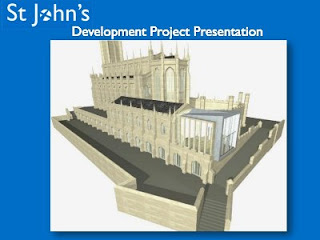
And then there is this description of how we put up a new building which reminded me irresistibly of my church's proposed 'development', which will remove my favourite suntrap terrace in Edinburgh and replace it with an oversized porch at a cost out of all proportion to any other church activity:
There are several buildings in Edinburgh, built between perhaps 1870 and 1940 - the National Portrait Gallery, the war memorial chapel in Edinburgh Castle and Fairmilehead Parish Church for example -- which I'm sure were fairly directly inspired by the Ruskin mindset. Ruskin has his cons as well as his pros -- he talks some right rubbish sometimes. But I wouldn't mind if the current architects of Edinburgh were a little more inspired by his nature-inspired, anti-pretentious, thinking.
I once thought his 'seven lamps' of architecture a mantra worth committing to memory: Truth, beauty, power, memory, sacrifice, obedience, life. There's a test for soundness in a building -- or a person!

Well, but, you will answer, you cannot feel interested in architecture: you do not care about it, and cannot care about it. I know you cannot. About such architecture as is built nowadays, no mortal ever did or could care. You all know the kind of window which you usually build in Edinburgh: here is an example of the head of one: a massy lintel of a single stone, laid across from side to side, with bold square-cut jambs—in fact, the simplest form it is possible to build. It is by no means a bad form; on the contrary, it is very manly and vigorous, and has a certain dignity in its utter refusal of ornament. But I cannot say it is entertaining. How many windows precisely of this form do you suppose there are in the New Town of Edinburgh? And your decorations are just as monotonous as your simplicities. How many Corinthian and Doric columns do you think there are in your banks, and post-offices, institutions, and I know not what else, one exactly like another?—and yet you expect to be interested!

And then there is this description of how we put up a new building which reminded me irresistibly of my church's proposed 'development', which will remove my favourite suntrap terrace in Edinburgh and replace it with an oversized porch at a cost out of all proportion to any other church activity:
In your public capacities, as bank directors, and charity overseers, and administrators of this and that other undertaking or institution, you cannot express your feelings at all. You form committees to decide upon the style of the new building, and as you have never been in the habit of trusting to your own taste in such matters, you inquire who is the most celebrated, that is to say, the most employed, architect of the day. And you send for the great Mr. Blank, and the Great Blank sends you a plan of a great long marble box with half-a-dozen pillars at one end of it, and the same at the other; and you look at the Great Blank's great plan in a grave manner, and you dare say it will be very handsome; and you ask the Great Blank what sort of a blank check must be filled up before the great plan can be realized; and you subscribe in a generous "burst of confidence" whatever is wanted; and when it is all done, and the great white marble box is set up in your streets, you contemplate it, not knowing what to make of it exactly, but hoping it is all right; and then there is a dinner given to the Great Blank, and the morning papers say that the new and handsome building, erected by the great Mr. Blank, is one of Mr. Blank's happiest efforts, and reflects the greatest credit upon the intelligent inhabitants of the city of so-and-so; and the building keeps the rain out as well as another, and you remain in a placid state of impoverished satisfaction therewith; but as for having any real pleasure out of it, you never hoped for such a thing. If you really make up a party of pleasure, and get rid of the forms and fashion of public propriety for an hour or two, where do you go for it? Where do you go to eat strawberries and cream? To Roslin Chapel, I believe; not to the portico of the last-built institution.

There are several buildings in Edinburgh, built between perhaps 1870 and 1940 - the National Portrait Gallery, the war memorial chapel in Edinburgh Castle and Fairmilehead Parish Church for example -- which I'm sure were fairly directly inspired by the Ruskin mindset. Ruskin has his cons as well as his pros -- he talks some right rubbish sometimes. But I wouldn't mind if the current architects of Edinburgh were a little more inspired by his nature-inspired, anti-pretentious, thinking.
I once thought his 'seven lamps' of architecture a mantra worth committing to memory: Truth, beauty, power, memory, sacrifice, obedience, life. There's a test for soundness in a building -- or a person!
Wednesday, 8 August 2012
Robert Downie and the big heart of Regency Edinburgh
200 years ago today, on 8 August 1812, the Caledonian Mercury newspaper noted the arrival of a new face in Edinburgh. They didn't even know his name, but he must have made an impressive entrance:
 He was Robert Downie: he was 41 years old, vastly rich, and he had come home.
Robert Downie's father was a farmer and distiller in Spittaldon, half way between Stirling and the Trossachs: perhaps he was one of the moss lairds who migrated from the Highlands to drain the bog and improve the lands of the Forth Valley. Downie himself undertook a far longer journey to seek his fortune, to India.
Most of the Edinburgh New Town residents I have studied who made fortunes in India enjoyed an official appointment in the East India Company, courtesy of the patronage of Henry Dundas. Robert Downie had no such privilege. He went to Calcutta, where private 'Houses of Agency' were springing up from the 1780s. They financed ships and plantations, ran banks and insurance, and arranged cargoes and remittances. By 1800 they were so successful that their trade in Bengal eclipsed that of the Company. Downie rose to become a partner in one of these houses, Downie and Maitland, which later metamorphosed into the more well-known Cruttenden, MacKillop and Co.
In 1804, aged 33, He married Mary, 18-year-old daughter of one of the Establishment: Joseph Barnard-Smith, a rising merchant in the East India Company. By the time he returned to Scotland the couple had four daughters, Mary, Georgina, Roberta and Harriet, although Mary died soon after their arrival.
The Downies settled at no.20 Charlotte Square, where in 1814 Mary had a son, also Robert. The residents of Charlotte Square were amongst the wealthiest in Edinburgh, but were notable for their mixed social backgrounds: William Arbuthnot at no.16 was the son of a failed businessman in Aberdeen. Henry Cockburn at no.14, opposite his friend John Tod at 46, came from solid local landed families, and had risen in the legal profession. Next door to the Downies at no.19, Thomas Allan came from a dynasty of Edinburgh bankers. At no.7, with a longer pedigree but a shorter pocket, the clan chief John Lamont of Lamont was on the point of having to sell up, his ancestral wealth unable to keep pace with these beneficiaries of Scotland's economic miracle.
Yet this was before the days when Edinburgh turned in on itself and peeked at its neighbours from behind lace curtains. These first inhabitants of Charlotte Square, many of whom had young children, formed a flourishing community characterised by long and happy marriages, an idealistic belief in their ability to improve their society, and an abundance of good food in informal settings. Picnics in the Pentlands, jaunts to country houses, and suppers at in one another's parlours form (along with politics and civic engagement) the material of their letters. Downie, the mysterious traveller from another world, had arrived in what appears to be history's happiest communities.
Downie threw himself into the Scottish craze for Improvement. Three years after his return, he was chair of the Company which promoted the Telford's Union Line of the canal from Edinburgh to Glasgow, in opposition to the Town Council who were championing an impractical and circuitous 'Upper Line'. The Union Line was ultimately successful, and Downie, the major shareholder, gave his name to the street (Downie Place, now a part of Lothian Road) which looked onto the final port in the canal, Port Hopetoun, which came in under a bridge over Semple Street and filled the area between Semple Street and Lothian Road.
Robert Downie was a religious man, and his philanthropy suggests a certain greatness of heart. He was a major investor in the Episcopal Chapel of St John's which was built in 1818 conveniently between his house in Charlotte Square and his Canal site on Lothian Road, and a member of its first Vestry. On his return from India he had bought the Highland estate of Appin from the Marquis of Tweeddale. Thirty years later, the Presbyterian minister of Appin said of him, 'I do not think that there is a parish in Scotland in which the Episcopalian heritors deserve at the hands of the Establishment more honourable mention'.
Downie had learned Episcopalianism in India, where the Anglican Church predominated. On the mosses of Spittalton he had been brought up a Presbyterian, and one might imagine that he would be eager to erase this lowly past, and remain the mysterious traveller whose history began in India. Yet soon after his return to Scotland he 'presented to the congregation of Norriestown, an elegant service of four silver communion cups, as a tribute of the regard for that religious establishment, which he attended in his youth.'
Downie went on to enter parliament for the Stirling Burghs, and died in 1841. A shrewd businessman yet generous, open-minded yet committed to his beliefs, travelling the world yet attached to places, Robert Downie was one of the people who made Regency Edinburgh such an exciting place to be.
More information and sources are available on Robert Downie's page at The Episcopal Congregation of Charlotte Chapel project website.

Robert Downie's father was a farmer and distiller in Spittaldon, half way between Stirling and the Trossachs: perhaps he was one of the moss lairds who migrated from the Highlands to drain the bog and improve the lands of the Forth Valley. Downie himself undertook a far longer journey to seek his fortune, to India.
 |
| Spittaldon, Menteith, Stirlingshire |
Most of the Edinburgh New Town residents I have studied who made fortunes in India enjoyed an official appointment in the East India Company, courtesy of the patronage of Henry Dundas. Robert Downie had no such privilege. He went to Calcutta, where private 'Houses of Agency' were springing up from the 1780s. They financed ships and plantations, ran banks and insurance, and arranged cargoes and remittances. By 1800 they were so successful that their trade in Bengal eclipsed that of the Company. Downie rose to become a partner in one of these houses, Downie and Maitland, which later metamorphosed into the more well-known Cruttenden, MacKillop and Co.
In 1804, aged 33, He married Mary, 18-year-old daughter of one of the Establishment: Joseph Barnard-Smith, a rising merchant in the East India Company. By the time he returned to Scotland the couple had four daughters, Mary, Georgina, Roberta and Harriet, although Mary died soon after their arrival.
The Downies settled at no.20 Charlotte Square, where in 1814 Mary had a son, also Robert. The residents of Charlotte Square were amongst the wealthiest in Edinburgh, but were notable for their mixed social backgrounds: William Arbuthnot at no.16 was the son of a failed businessman in Aberdeen. Henry Cockburn at no.14, opposite his friend John Tod at 46, came from solid local landed families, and had risen in the legal profession. Next door to the Downies at no.19, Thomas Allan came from a dynasty of Edinburgh bankers. At no.7, with a longer pedigree but a shorter pocket, the clan chief John Lamont of Lamont was on the point of having to sell up, his ancestral wealth unable to keep pace with these beneficiaries of Scotland's economic miracle.
Yet this was before the days when Edinburgh turned in on itself and peeked at its neighbours from behind lace curtains. These first inhabitants of Charlotte Square, many of whom had young children, formed a flourishing community characterised by long and happy marriages, an idealistic belief in their ability to improve their society, and an abundance of good food in informal settings. Picnics in the Pentlands, jaunts to country houses, and suppers at in one another's parlours form (along with politics and civic engagement) the material of their letters. Downie, the mysterious traveller from another world, had arrived in what appears to be history's happiest communities.
Downie threw himself into the Scottish craze for Improvement. Three years after his return, he was chair of the Company which promoted the Telford's Union Line of the canal from Edinburgh to Glasgow, in opposition to the Town Council who were championing an impractical and circuitous 'Upper Line'. The Union Line was ultimately successful, and Downie, the major shareholder, gave his name to the street (Downie Place, now a part of Lothian Road) which looked onto the final port in the canal, Port Hopetoun, which came in under a bridge over Semple Street and filled the area between Semple Street and Lothian Road.
 |
| The original Union Canal basin facing the Canal Company's own street, Downie Place, now a section of Lothian Road containing some very useful shops. From John Wood's 'Plan of the City of Edinburgh' (1831) |
Robert Downie was a religious man, and his philanthropy suggests a certain greatness of heart. He was a major investor in the Episcopal Chapel of St John's which was built in 1818 conveniently between his house in Charlotte Square and his Canal site on Lothian Road, and a member of its first Vestry. On his return from India he had bought the Highland estate of Appin from the Marquis of Tweeddale. Thirty years later, the Presbyterian minister of Appin said of him, 'I do not think that there is a parish in Scotland in which the Episcopalian heritors deserve at the hands of the Establishment more honourable mention'.
 |
| St John's Chapel in 2012: the canal has been superseded as a form of transport by the buses, and the Town Council's latest transport lark, the trams, are under construction. |
Downie had learned Episcopalianism in India, where the Anglican Church predominated. On the mosses of Spittalton he had been brought up a Presbyterian, and one might imagine that he would be eager to erase this lowly past, and remain the mysterious traveller whose history began in India. Yet soon after his return to Scotland he 'presented to the congregation of Norriestown, an elegant service of four silver communion cups, as a tribute of the regard for that religious establishment, which he attended in his youth.'
Downie went on to enter parliament for the Stirling Burghs, and died in 1841. A shrewd businessman yet generous, open-minded yet committed to his beliefs, travelling the world yet attached to places, Robert Downie was one of the people who made Regency Edinburgh such an exciting place to be.
More information and sources are available on Robert Downie's page at The Episcopal Congregation of Charlotte Chapel project website.
Subscribe to:
Posts (Atom)